Author and publisher of stories about fascinating Prairie People and unsung Canadian heroes

Welcome to the blog of Deana Driver - retired author, editor, book publisher and freelance journalist. Deana retired in 2026 and closed her business, DriverWorks Ink, which published stories of inspiring, fascinating Prairie people and unsung Canadian heroes written by Prairie authors, including Deana Driver. DriverWorks Ink also published genres of healing and wellness, rural humour, and children's historical fiction.
Showing posts with label The Little Coat book. Show all posts

Friday, May 31, 2024

Honouring Those Who Served - 80th Anniversary of D-Day


Thursday, June 6, 2024, will mark the 80th anniversary of the D-Day landings along the Normandy coast during the Second World War. This event by Allied forces, which ultimately led to the liberation of Europe, will be commemorated at various places, including Juno Beach Centre in France.

In 2013, my late husband Al and I visited Juno Beach and carried a copy of Alan J. Buick's award-winning book The Little Coat: The Bob and Sue Elliott Story with us onto the beach. It was eerie and emotional to walk on those grounds where so much occurred.

The late Bob Elliott was a Canadian tank commander who arrived in France at Juno Beach - an overwhelming experience he was able to survive while many others perished in battle. The little coat he and his troop commissioned to be sewn out of a Canadian army blanket as a gift for a sympathetic Dutch girl is now an artifact in the Canadian War Museum in Ottawa because of Alan Buick's fantastic book.

The Little Coat is one of several books published by DriverWorks Ink that share stories of those who served in the Second World War and other conflicts in the name of world peace.

We recommend that you read:
- Crash Harrison: Tales of a Bomber Pilot Who Defied Death, written by Deana J. Driver (that's me), about a Saskatchewan farmboy who grew up during the Great Depression and survived four airplane crashes in England during World War II;
- See You in Le Touquet, written by Romie Christie about her lawyer father's work as an Army officer during World War II and how he liberated his future wife (Romie's mother) and her town of Le Touquet, France as the war was ending;
- all three of the books in the series Flight: Stories of Canadian Aviation, which share vignettes and memories of brave military personnel serving around the world; and
- The Sailor and the Christmas Trees, written by Deana Driver, about a Manitoba man's kindness to shipmates and others in the middle of the Atlantic Ocean on Christmas Day 1944.
All these books are available from https://driverworks.ca/

We share the sentiment of Sussie Cretier, the Dutch girl in The Little Coat story, who said as an adult, "My gratitude for the young men who gave up their youth and their lives for the freedom of our country. I never, ever will forget."

Wednesday, November 10, 2021

Remembrance - Bob and Sue Elliott and their Little Coat

Every year since November 2009, when I published Alan J. Buick’s book The Little Coat - The Bob and Sue Elliott Story, I can’t help but think of Bob and Sue Elliott on Remembrance Day.

They were unsung Canadian and Dutch heroes of a sort. Until Alan’s book, of course, which helped thousands of readers worldwide learn their names and something about the sacrifices made by them and people like them who served in and/or lived through the combat zones of the Second World War.


Bob enlisted in the Canadian Army in Calgary when he was only 15 years old. My oldest grandson is close to that age now and I can’t imagine the fear and worry of being unable to do anything but watch that young man go off to war as Bob did, having told recruiters that he was 20 years old and wanted to follow in the footsteps of his older brothers.

By age 19, Bob Elliott was a tank commander in the Canadian Army and was fighting the German army in the Netherlands. There, he met a feisty, 10-year-old Dutch girl named Everdina “Sussie” Cretier. Sussie had earlier saved her father from a German firing squad and their whole family had just escaped to the safety of the Canadian army after running across a field dotted with landmines.

Sussie - soon known as Sue - became a good-luck charm for the Canadian soldiers, especially those in Bob’s troop, who wanted to give her a Christmas gift. On Christmas Day 1944, Bob presented Sue with a child’s coat that the soldiers had asked a local seamstress to sew out of a wool Canadian Army blanket. The buttons on the coat came from the soldiers’ tunics.

Sue cherished that gift and kept it for decades, long after she and Bob reconnected and she moved to Canada to be with him. Alan Buick saw the coat on display at the Royal Canadian Legion in Olds, Alberta, and began asking questions about it - which led him to write his award-winning book, The Little Coat.

Bob Elliott passed away in February 2013.

We learned today that Sue Elliott passed away in May of this year. We express our heartfelt condolences to their families and all who loved them.

I was privileged to meet and talk with Sue and Bob during our launch of The Little Coat book from the Royal Canadian Legion hall in Olds, Alberta in November 2009. They connected with us by video, long before that became an everyday occurrence. Alan Buick and I were thrilled that the subjects of Alan's book could participate in our launch and visit with their family members and friends in the audience via video chat. 

In 2013, I was thrilled to meet Sue in person in the Netherlands, when I travelled there on a vacation with my late husband, Al. I wrote a blog about that adventure, from the perspective of the book talking to us. It was great fun and Sue was, as always, energetic and full of laughter.

Bob and Sue’s story and sacrifices will never be forgotten. Nor will those of thousands of others who served and placed themselves in danger in the name of freedom.

We will remember them. Rest in peace, dear friends.


Bob and Sue Elliott in 2010 with a tank
resembling the one Bob used in the war

Alan Buick, author, views The Little Coat ("child's coat")
on display in the Canadian War Museum, Ottawa, 2010

-----------------------------------

More of my blog posts about Bob and Sue Elliott:

Seeing this "Little Coat" inspired a country singer to write an award-winning book, Dec 2017

Viewing The Little Coat at the Military Museums, Calgary, Alberta, August 2015

Liberation Day Netherlands 70th Anniversary and The Little Coat book, May 2015

Remembrance - Bob Elliott and The Little Coat book, Nov 2014

From Blanket to Coat to Book to Painting, June 2013

The little coat is 67 years old! Dec 2011

Monday, February 1, 2021

A Funny Thing Happened at a Craft Show

I miss craft shows. Actually, I miss seeing real people with their faces visible, but that's another story.

I miss the busy craft show atmosphere of talking with all variety of folks and selling books to interested readers. Craft and trade shows on the Prairies have been part of my life every fall since 2009 when I published The Little Coat: The Bob and Sue Elliott Story by Alan J. Buick. That fall, the author and I and our spouses (Carol and Al) went on an epic author tour through parts of Saskatchewan and Alberta to launch this wonderful book about a Canadian soldier from Olds/Calgary and a Dutch girl who received his troop's wartime gift of a child's coat made from a Canadian Army blanket. 

The Little Coat is still one of our most popular titles - for good reason, including the fact that the coat is now an artifact in the Canadian War Museum thanks to Alan's writing efforts - and it launched us into the world of selling our books at trade shows and craft shows as well. We had a trade show booth at big events like Canadian Western Agribition for many years and we took our books on the road to various craft shows in all regions of Saskatchewan as well as southern Manitoba and Alberta. Fun stuff for sure.

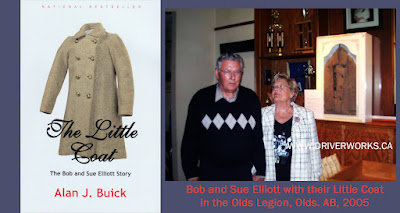
The Little Coat: The Bob and Sue Elliott Story by Alan J. Buick

But people do say the darnedest things sometimes.

One of the funniest - or maybe strangest - moments that happened came during a show in a Saskatchewan town in November 2012. The craft show was held in a large gymnasium-like room and there was plenty of space for craft tables and for customers to wander among them. (Sigh. Did I mention that I miss people?) 

Anyway, I returned to the room after a short break and an older woman greeted me at the door. She called to her friend to follow her and they both walked behind me, following me for the entire length of the large room until I got to my table. They stopped in front of my table and waited until I sat down in my chair behind the table.

Then the woman picked up my Never Leave Your Wingman book - about fun-loving, inspiring, seven-time cancer survivor Dionne Warner and her wingman husband Graham - and held the bright pink book up for her friend to see.


"They say this is a really good book," the woman said to her friend.

Then she put the book down and they both walked away.

What... was... that? I wondered for a long, long time - when I wasn't laughing and shaking my head, that is.

She never did buy the book. Not that weekend anyway.


At another craft show - in a city this time - a woman came up to my booth and asked if she could buy "that big book." 

I was confused. All the books I publish are of a standard size - either 6 inches wide by 9 inches high or slightly smaller. I have published only a couple of books that are 8-1/2 inches by 11 inches, so I didn't understand what she was wanting. I asked her to repeat herself.

"I want to buy that big book. There!" she said as she pointed to the 12-inch by 18-inch poster of a book cover that was hanging on the booth wall behind me.

"Um... those are just posters of the book covers. The books are here," I said as gently as I could while I motioned to all the books covering the tables between us.


I don't remember if the woman ended up buying an "actual" book or not - I think she did - but I distinctly remember that she was not the only person who asked if they could buy one of the book posters. One other person inquired at a different trade show a few years later.

So maybe there's a market out there for oversized books. Hmmm...


As my publishing business grew and my display table of books by various authors expanded during the past 10 years, my routine of briefly introducing the books on my table became more complex. Sometimes the words that came out of my mouth were confusing for craft show visitors and for myself as well. (I'm better at writing than I am at talking.)  As I honed my publishing preferences to focus only on non-fiction books and other genres related to non-fiction, it became easier for me to describe the books on my craft show tables. At least that's what I thought was happening.

"Hello. These are all books I publish," I'd say. "They're all written by Saskatchewan and Prairie authors, including me. These ones are all true stories (as I pointed out the books), these are healing and wellness, these are children's fiction and non-fiction, and these are humour and cowboy poetry over here. They're all true stories or based on true stories."

It sounded simple enough to me but, then again, this is my business and I deal with these books daily, so it should sound understandable to the person who creates the books. Let me tell you, it definitely boggles the minds of some folks who wander up to my craft show tables. Usually, I can sort out their questions and help them understand whatever it is that they want to know about the awesome books written by awesome writers. (Shout out to my authors!)

But sometimes, nothing I say really matters.

I recall spending five or ten - or maybe it was a hundred - minutes one day talking to a man about the different books he appeared to be interested in on my craft show tables. He had asked about some of the storylines, whether this one was a Saskatchewan story or not, whether these people were still alive... and more. Then came the question that floored me.

"So, have you read any of them?" he asked.

Uh.... What?

"Yes," I replied, trying to keep him from seeing how astounded I was at his question. Hadn't I just told him about almost Every. Single. One. Of these books?

"I edited and published all of these books, so, yes, I've read every word in every one of them. Many times," I said.

The guy eventually walked away. I was glad to see him go. Sometimes you just can't help people.


The final memorable funny moment came when two young girls, about 10 years old, stopped at my booth one evening and began looking at the children's and young adult books. They picked up one kids' book and then another and began conversing with me.

And that's when my "I've read every word in every one of these books" line came back to haunt me.

One of the young smarty-pants girls picked up The Inquiring Reporter by Clay Stacey and randomly opened it up. "Okay, I'm on page 68. The word starts with a p and ends with r. What is it?" the youngster brazenly asked as she looked straight at me.

"Publisher," I replied, without hesitating.

The little girl's eyes opened wide as she looked at her friend in shock. "Wow! She really does know every word in the books!"

She quickly put the book down and they almost ran as they left my booth.

I smiled.

Yes, of course, I got lucky with "publisher", but it was a pretty easy guess. The book's author, Clay Stacey, was a publisher, editor, and reporter in all four Western provinces for 50 years - so "publisher" seemed like a reasonable option for a word that starts with p and ends with r - in a book about a publisher!

However, I am glad that she didn't look a little farther down the page and pick out the word starting with a u and ending with a y...

Unpredictability.


Thursday, December 7, 2017

Seeing this "Little Coat" inspired a country singer to write an award-winning book

Canadian soldier Bob Elliott and his crew asked a Dutch seamstress to make this child's coat from a Canadian Army blanket. The buttons came from the soldiers' tunics. The soldiers gave the coat to their "good-luck charm", 10-year-old Sussie Cretier, on Christmas Day 1944.
Alan J. Buick was a full-time carpentry instructor and a part-time country singer when he noticed the unique child's coat in a case on display in Olds, Alberta. Here is  what the first glimpse of that little coat meant to him:

Seeing the “little coat” for the first time - at the Royal Canadian Legion in Olds, Alberta in September 2004 - filled me with bewilderment more than passion. I asked a friend, who had come to hear my wife Carol and I play music that night, why this coat with Canadian Army buttons was displayed with all the wartime memorabilia; it was far too small for a soldier to have worn. My friend proceeded to relate some of the story behind its creation – it was a Christmas gift in 1944 from Canadian soldiers to a 10-year-old Dutch girl who had become a good-luck charm for them; she later brought the coat to Canada.

It was then that my passion for this tale began.

The most powerful moment was when I learned that the little Dutch girl who wore the coat and the soldier who gave it to her were not only still alive in 2004, but married to each other! I knew I had an epic by the tail! I had to find out more.

I contacted Bob and Sue Elliott - the Canadian soldier and the Dutch girl - who were at that time living in the Netherlands. The email address I'd been given for them failed, so snail mail was the only other choice. They replied to my letter and the journey to turn their story into a book began.

These were Sue's words: "I have no problem telling you what it was like growing up under Nazi rule, but good luck when you get to Bob!”

She was right. Bob, like many veterans, preferred not to talk about the horrors of war; the recollections opened old wounds long forgotten.

Bob and Sue and I met face-to-face at the Royal Canadian Legion hall in Olds, Alberta in October 2005 to discuss the procedure for writing this book. It was a truly amazing day. Just talking to these two wonderful people who had endured so much was an awe-inspiring experience for me.

 
Bob and Sue (Sussie) Elliott in 2005 with Sue's little coat on display at the Royal Canadian Legion in Olds, Alberta, Canada.

I knew I had not collected all the information I needed that day. The journey I had chosen was both humbling and difficult. I was dealing with 65-year-old memories! A good example of this was the day before my publisher, Deana Driver, was to send the manuscript off to print, Sue told me of the German soldier who visited with her family frequently. This information had to be included in the book as it showed how not all German people were evil.

At the close of our 2005 meeting, Sue asked me what she should do with her little coat. I said it should be in a museum, where it would inform future generations of the compassion and generosity Canadian soldiers had for the emaciated and spiritually worn-down peoples of the Netherlands. They contacted the Canadian War Museum, which promptly sent two representatives to the Olds Legion to carefully prepare this ancient garment for the long flight to Ottawa.

 
Alan J. Buick, author of the award-winning, Canadian best-selling book The Little Coat: The Bob and Sue Elliott Story, available from www.driverworks.ca
  
Prior to the official book launch, scheduled to take place at the Olds Legion on November 11, 2009, a pre-launch gathering was held at the Armoury Officers' Mess in Regina. As strange as it may sound and with fate in our corner, one of the officials from the Embassy of the Kingdom of the Netherlands happened to be present that night, Hans Moor. We gave him a copy of my book, The Little Coat: The Bob and Sue Elliott Story, and he read it on his flight back to Ottawa.

A few weeks later, I was invited by him to attend a function at the Canadian War Museum in Ottawa to honour the Canadian soldiers of World War II who repatriated the Netherlands. This was an amazing evening. There was I, a New Zealand farmboy, rubbing shoulders and chatting with Dutch Ambassador Wim Geerts and General Charles Belzile, retired commander of the Canadian Forces! A truly humbling and memorable experience.

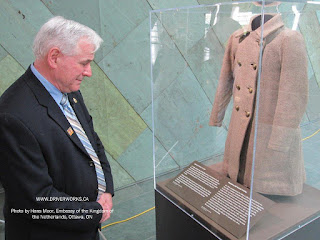
My most touching moment on that trip was seeing "the child's coat" in its restored state and mounted in a beautiful glass case, complete with a bronze plaque briefly explaining what it was and what it represented. It literally brought me to tears. The War Museum staff had done an excellent job of presenting this wonderful artifact.

 
Alan J. Buick seeing the child's coat at the Canadian War Museum.
(Photo courtesy of Hans Moor, Embassy of the Kingdom of the Netherlands, Ottawa, ON) 

It is difficult to pinpoint any incident I told in The Little Coat book as being more significant than another but, if I were to pick just one, it would be when Sussie's (Sue's) family escaped on foot for two kilometres to the safety of the Canadian lines while her family was under fire from German soldiers.

The Little Coat is a perennial story, a story of love and compassion, of terror and human relationships – a perfect gift for men, women, and children ages 10 and up, or even just because. Once you read it, you'll understand the gratitude the Dutch still have for Canadians today and forever. This book captures the true compassion of the Canadian soldiers for the Dutch people in their darkest hour.


Editor's note: The Little Coat: The Bob and Sue Elliott Story was awarded Honourable Mention, 2010 Hollywood Book Festival. $4,500 from sales of The Little Coat has been donated to the Royal Canadian Legion Dominion Command Poppy Trust Fund. $1 from every book sold from 2013 on is donated to the Canadian War Museum, the new home of the 'child's coat' in this inspiring war story turned love story.


Monday, November 25, 2013

Belgium, Netherlands & a Special Lady - Europe Adventure Blog Part 9

Have you ever been to Belgium? It's beautiful.

I'm the Never Leave Your Wingman book. (Yes, you read that correctly - I'm a book.) My author/publisher Deana Driver and I, plus Deana's husband/publisher partner Publisher Al, were in Bruges in August as part of our wonderful European adventure (see my first blog). We only spent a day in Belgium because we had so many other wonderful places to visit on our agenda ... but what we saw was beautiful and enough to make us want to go back again.. Allow me to share some of the great sights and sites from this beautiful city.

Oh, hello, Publisher Al! Are you going to lead us on our tour of Bruges?
No? Good thing. I don't think you'd fit in this little tourist vehicle.

Bruges - or Brugge, as the locals refer to it - is one of several European communities that calls itself 'Venice of the North'. We were impressed by its canals, which are tranquil and lovely. These swans and other various birds thought so, too.

Picture-perfect.

Here are some common sights in downtown Bruges:
Horse and buggy rides past quaint little shops...
...which sell Belgian chocolates...

...and Belgian waffles, of course. (Psst... the bananas topping that my author ordered contained grand marnier. Yummmm!)

Bruges is famous for its lace. Many shops sell it and many homes and businesses have lace curtains and/or needlework pieces that show the richness of the local culture...

...these items are all handmade. Gorgeous.

Oh, Publisher Al. Now those are super-sized fries!

After Bruges, we were anxious to get to Holland. 

We had some special plans for the Netherlands. Several special plans, in fact.

First, we wanted to get to the town of Groesbeek in eastern Netherlands before 5 o'clock that day.

This involved driving across a tiny one-way bridge (the crossings were controlled by traffic signs showing who must yield the right-of-way)...
...through a forest which had a sign warning of wild boars crossing the road. 
Now that's not a sign I've seen in western Canada. I've been told we do have wild boars in some areas of southeast Saskatchewan, but I've never seen a sign for them.
Then again, I am a book... so enough said about that.

We saw this windmill as we arrived in Groesbeek, Netherlands. We were disappointed that it was the only windmill we saw in all our time in the Netherlands, but we did see a lot of wind turbines in the Netherlands and several other European countries. Between those and many fields full of solar panels, we determined that Europe is far ahead of Canada in alternative energy sources.


So we made it to this - the National Liberation Museum in Groesbeek - before it closed for the day. The man at the desk was reluctant to take the entry fee from my publishers because the museum was closing in an hour, but they convinced him to 'just take the money' and then point them in the direction of this important exhibit....
...a series of paintings by Calgary, Alberta artist Bev Tosh, called Canadian War Brides: A one-way passage to love. My publishers - who also published my friend The Little Coat: The Bob and Sue Elliott Story by Alan J. Buick - were so happy to see the exhibit that my author was like a little kid, smiling and jumping up and down with excitement. 


 And this was the panel that my publishers came to see.

Everdina (Sussie) Cretier was 10 years old when she received a little coat, made from a Canadian army blanket, as a gift from Canadian tank commander Bob Elliott and his crew on Christmas Day 1944. Decades later, Sussie/Sue and Bob reconnected and fell in love.Sue still had her little coat. She brought it with her to Canada and married Bob, her hero.

Although Sue is not technically a 'war bride', her story (as told by Alan Buick in my book friend The Little Coat) inspired Bev Tosh to create a portrait of Sue for her wonderful exhibit of Canadian war brides. (My author blogged about Bev's exhibit a few months ago, explaining that Bev used Bob and Sue's wedding photograph as the model for her painting.)
Each painting also has an accompanying  description of the war bride, and Sue's painting was at the end of the row, and the first one my publishers saw when they entered the exhibit room.
My publishers quickly pulled out the three The Little Coat books they brought with them (hiding them from me until just a couple days earlier, I might add), and they asked another museum visitor to take this photo of them with the exhibit.  
These are some of the other paintings and displays in Bev Tosh's exhibit, but Sue Elliott was the most important to my publishers, of course.

So we all went to bed very excited that night, and the next day, we were in for a very special visit. 

We drove to the nearby town of Rossum, going through the lock that Sussie Cretier-Elliott's family had crossed in 1944 to escape from the German soldiers to the safety of the Allied forces.


We drove into town and went to a seniors' complex - where we met this wonderful woman... 
...Sue Elliott, the woman who received that wartime gift of a coat from Alberta soldier Bob Elliott and his crew in 1944!
It was no surprise to us that Sue is just as feisty as ever. When we arrived, she apologized for her apartment being a bit untidy. (It wasn't, actually, but she thought it was.) She had just finished washing the bathroom floor, you see, because she can do it better than the people who are employed by the residence to do the cleaning, she said! What a character.

My publishers loved every minute they spent with Sue....  
...from the visiting and sharing of stories to the long walk we took around the neighbourhood.

Sue showed us where her late husband, Bob Elliott (the soldier in the story, who passed away in February 2013) used to go every day to sit and watch the ships and boats sailing down the canal. 

It is beautifully peaceful.

She took my publishers through town and showed them the shop where her father had his garage. The family's house used to be where the large window is on the first building on the right. Sue's brother Gerard runs the business now. 

Here, my friend The Little Coat looks back on the scene that author Alan Buick captures so well with his writing.

On our walk, Sue showed us some local vegetation. This was the first time my publishers had seen a walnut tree...


...and the first time they'd eaten blackberries off a bush. What's the matter, Publisher Al? Was that berry a little sour? If you look closely, it almost seems like Sue knew that when she handed it to him. Hee hee.


We had a lovely visit with the amazing Sue Elliott...
...but we had to say goodbye to her, leaving her with one of the three copies of The Little Coat book that my publishers had brought to Europe and set on the sand at Juno Beach. When we arrived home, my publishers put one of the two remaining copies (signed by Sue Elliott) on their bookshelf and gave one to author Alan Buick, along with some photos of their visit with Sue. Just as they surprised me with this vacation, they did not tell Alan ahead of time that they might be meeting Sue. Only her daughter Trudy knew of the possibility. (Thank you, Trudy, says my author.) Alan was pleased as punch with his gifts.

Anyway, back in Holland....

...we also drove to the nearby town of Alphen, to see the landscape of the area where Sue's family had sought safety from the Canadian soldiers. 

It was hard to imagine this beautiful land as it would have been during wartime.

Then we went to the Groesbeek Canadian War Cemetery, which honours so many who fought and died in that area during the Second World War.


Row after row of headstones.


So we leave you with this thought... as Sue told us about her and her beloved Bob's story written by Alan J. Buick in The Little Coat book - "This book is a warning to never let it happen again."

We will not forget.

Take care.

(Next blog in this series.)


Saturday, November 9, 2013

Our European Adventure Pauses To Remember - Blog Part 8 - Juno Beach, Dieppe & Vimy

This is the Never Leave Your Wingman book speaking. As you may know, I am a true story about Dionne Warner, a seven-time cancer survivor in Regina, Saskatchewan, Canada who dresses in costume and dances into her chemotherapy treatments, alongside her fun-loving husband/wingman Graham (who has also dressed in some pretty funny costumes, I must say). I've been blogging about the adventures I had in Europe this summer, after my author/publisher and her publisher husband took me along on their once-in-a-lifetime European vacation (read my first blog).

As Remembrance Day 2013 approaches, I'd like to use a good part of this blog to introduce you to a friend of mine, The Little Coat: The Bob and Sue Elliott Story book. My friend tells the amazing true war story/love story about a Canadian soldier, a little Dutch girl, and the coat that has linked them together forever.

In case you haven't guessed by now, my publishers are pretty sneaky at times... and unknown to me, they brought three copies (I'll tell you about all three later) of my friend The Little Coat along on our journey to Europe this summer. I didn't know about this sneaky move... and I didn't see my friend until we arrived here...
...at the Juno Beach Centre, in Courselles-sur-Mer of the Normandy region of France.


My publishers all of a sudden pulled my friend The Little Coat out of their backpacks. And I was so pleased. It was the perfect place for him. The Centre houses the Juno Beach museum, which contains artifacts and films and tells some of the incredible stories and details of the Second World War. I was honoured to go into this building and onto the actual Juno Beach with my friend The Little Coat.

Before I move on in this blog, please allow me to tell you more about The Little Coat:  The Bob and Sue Elliott Story. This award-winning, bestselling book is written by Saskatchewan author Alan J. Buick. It tells the true story of Alberta soldier Bob Elliott, who was 15 years old when he enlisted in the Second World War. Almost four years later, on June 6, 1944, Bob landed on Juno Beach as a member of the 19th Field Regiment. That day would later become known as D-Day. 

Bob survived that horrid battle and advanced further into France and then into the Netherlands. At age 19, in November 1944, he was a tank commander fighting the German troops in the Netherlands when he met 10-year-old Sussie Cretier. Sussie's family had just escaped to the safety of the Allied forces, and this feisty little girl soon became a good-luck charm and adopted little sister to many of the men in Bob's troop. The soldiers wanted to give Sussie a Christmas gift, so they took a Canadian Army blanket and gave it to a seamstress in that Dutch village, asking her to make it into a coat for Sussie. The buttons for the coat came off the Canadian soldiers' tunics. On Christmas Day, 1944, Bob gave Sussie the coat on behalf of his crew, and teh Canadians soon left Holland to continue with the advance against the German forces. More than 35 years later, Bob and Sussie (Sue) reconnected and fell in love. She still had the little coat. She brought it with her to Canada and married her hero.

As my publishers and I and our friend, The Little Coat book, looked around the grounds of Juno Beach, we could only think of Bob Elliott and the thousands of others who fought and sacrificed so much for our freedom.


 We were overwhelmed by their strength, their courage, and their sacrifices.


The Juno Beach Centre grounds and museum share stories of those who fought that historic battle.


Walking down the path toward the beach, we wondered how many men had died in this spot.
How many lost their lives here in the service of their country?
My publishers set The Little Coat on the sand at Juno Beach, in an homage to those who fought... and to honour the late Bob Elliott, our hero, who passed away earlier this year - on February 15, 2013.

We miss you, Bob. Thank you for your service.


From Juno Beach, we drove further up the coast to the French port of Dieppe. We wanted to see this significant spot at which 907 Canadians lost their lives in a failed raid in August 1942, which later informed more successful attacks for the Allied forces.


These Canadians are not forgotten, though. The beautiful Dieppe Square honours the Canadians who died in that raid. 


This plaque commemorates the more than 1,200 men, most of whom were Canadian, who died at Dieppe during that failed attempt at liberating France.


Each year since the end of the war, on August 19, ceremonies are held in Dieppe to commemorate that battle and the loss of life. Unaware of this annual event, we arrived in Dieppe and saw the displays set up in preparation for these ceremonies. Fascinating.


From Dieppe, we drove inland, towards Vimy, France, where we were anxious to see the great Vimy Ridge Memorial site.
About 30 kilometres southwest of Vimy, we began seeing cemeteries in the Pas de Calais region. These are the final resting places of soldiers killed in the First World War.


It was quite moving, driving through small towns surrounded by farmland and seeing these beautifully kept markers of soldiers known and unknown who died in the service of their country. We saw grave markers for Irish, Welsh, English, Australian, and Canadian soldiers. There was even one German soldier's grave marker.... and that was only in the first couple of rows of this cemetery.

There were many, many cemeteries in this region, all well-kept and providing an everlasting tribute to those who fell in the First World War. We were particularly moved by this often-seen grave marker:
'Soldier of the Great War. Known to God.'


The above statue, in the village of Puisieux, France, also commemorates the fatalities of war, as does the statue below. It stands in the village of Ayette and remembers the children who died from 1914 to 1918.


Arriving at Vimy, France, we walked through the museum and along the paths on the grounds, which still show the crevices caused by bombs and mines from the First World War.
The Battle of Vimy Ridge in 1917 was not one of Canada's most successful military achievements, but was significant for bringing Canadian forces together as a unified fighting force for the first time..
The Vimy Memorial site includes a piece of the trench from the war and memorials to those who served.

Signs warn visitors to not step over the electric fence because parts of the land, which has been donated to Canada by France for the memorial, contain undetonated explosives. 

The memorial is spectacular... from far away... 
...and up close.
Soldiers are honoured here by their names engraved on the memorial. Publisher Al touches the name of a J.A. Driver. He is not related to Al, but Al's grandfather did serve at Vimy.

Soldiers are also remembered here with gifts left by their loved ones. 
We will never forget.

One final comment in this blog commemorating those who fought for our freedom...

When we were at Juno Beach, my publishers set three copies of The Little Coat book down on the sand of Juno Beach., and they sprinkled a few grains of sand from that significant beach inside the pages of each of the books. 
Days later, they gave one of those special books to this amazing woman....

... Sussie (Cretier) Elliott - the 'little girl' who received 'the little coat' from Bob Elliott and crew in December 1944. 

But that's a wonderful story for my next blog.

In the meantime, please pause on November 11th to remember those who served and those who continue to serve today.